


These pages are for everyone affected by PROS: whether you live with PROS yourself, are the parent of a child with PROS, or are a young person growing up with PROS.
The information comes from GoPI3Ks, a UK charity for people with a PIK3CA mutation (Navigating your PROS journey). It was developed together with researchers at the Centre for Appearance Research (UWE Bristol) and people with PROS. You will find an explanation of PROS and how it can affect children, adults and parents, information for healthcare professionals, and exercises and resources. Many of the exercises and links come from the United Kingdom.
At the bottom of this page you will find links to the pages for children and young people, adults, parents and healthcare professionals.
PROS (PIK3CA-Related Overgrowth Spectrum) is a term for a group of conditions that can affect growth in different areas of the body. This can include the blood vessels, the skeleton (such as bone or limb differences) and the skin. It can also affect intellectual development, and there can be co-existing features such as asymmetry of the face or macrodactyly (enlarged fingers or toes).
PROS can also affect how someone looks, causing a visible difference. A visible difference is a distinct, noticeable physical feature, such as a scar, mark, birthmark or condition, that differs from what most people see as typical.
GoPI3Ks ran an anonymous online survey with multiple-choice and write-in questions. The questions covered many areas of life, such as finances, relationships, education and work, and medical experiences. The aim was to learn how PROS can affect a person’s life. Parents of children with PROS, young people and adults with PROS took part. The findings and quotes from the study are used throughout these pages. They also guided which topics are covered.
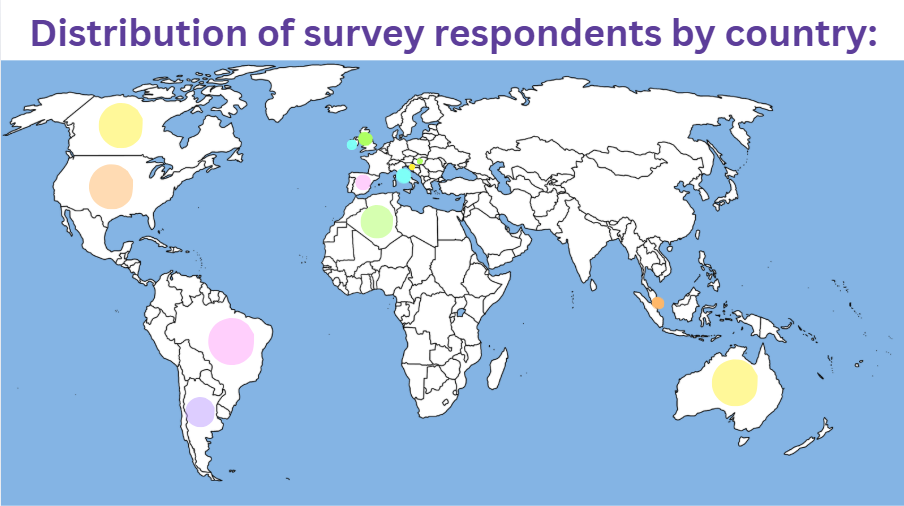
In total, 75 people took part: 41 parents of children with PROS, 32 adults with PROS and 2 young people with PROS. They came from 14 countries across North America, South America, Africa, Europe, Oceania and Asia, as the map shows.
Among adults and young people, Klippel-Trénaunay syndrome was the most common diagnosis. Parents said their child had most often been given a general diagnosis of PROS.
PROS can be a diagnosis in itself, but it can also be the umbrella term for one of the conditions in the image below. They are caused by a mutation in the PIK3CA gene, are rare and show up differently from person to person.
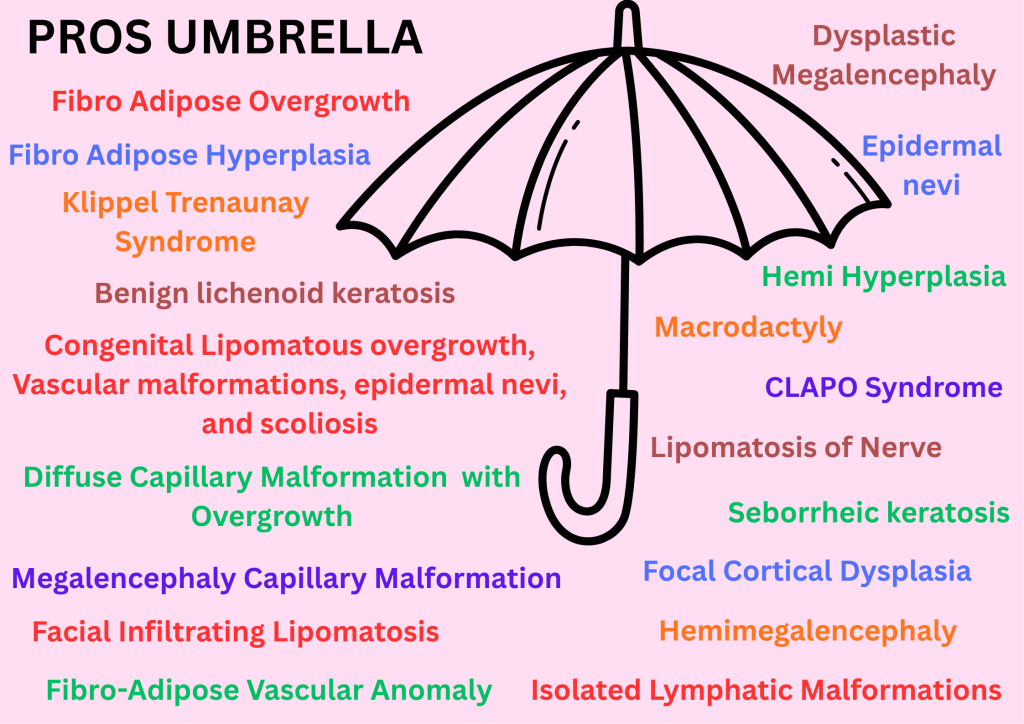
A short explanation of each condition is at the top of the PROS page.
This information is based on Navigating your PROS journey by GoPI3Ks, created together with the Centre for Appearance Research (UWE Bristol) and people with PROS. The images and worksheets are by GoPI3Ks. Back to PROS (PIK3CA-Related Overgrowth Spectrum).