


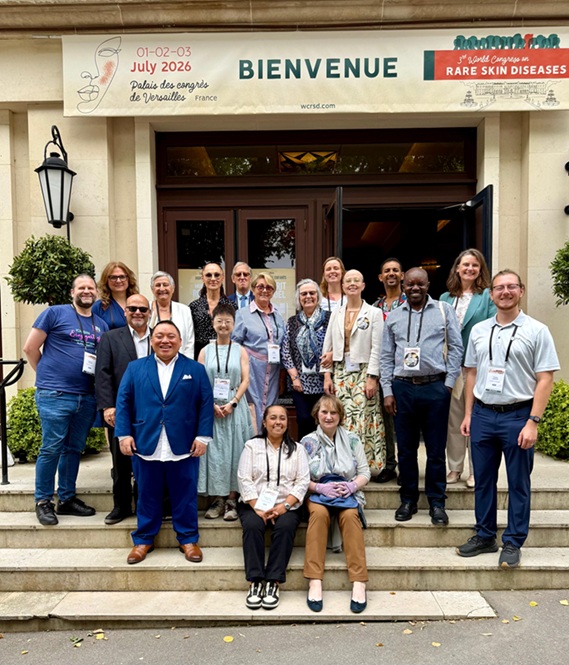
From 1–3 July 2026, the World Congress on Rare Skin Diseases (WCRSD) was held in Paris. The congress brought together more than 500 participants, with 71 speakers from 64 countries.
Tari de Jong, Secretary of CMTC-OVM, and Lex van der Heijden, President of CMTC-OVM, attended the conference.
Together with several other patient organisations from ERN Skin, we were present at the congress.
Congress Objectives
The congress focuses on sharing the latest knowledge and strengthening collaboration in the field of rare and complex skin disorders. The main objectives are:
- Enhancing knowledge of diagnosis and treatment
To gain a better understanding of the diagnosis, pathophysiology, and classification of rare and complex skin disorders. Topics include skin cancer and aggressive tumours, autoimmune blistering diseases, complex vascular malformations and tumours, autoinflammatory and autoimmune skin disorders, and various rare genetic and dermatological conditions. - Strengthening a multidisciplinary approach
To improve collaboration between different medical disciplines and develop the skills needed to better recognise and manage common challenges faced by people living with rare and complex skin disorders. - Keeping up to date with the latest developments
To gain greater insight into the latest research findings and developments in skin biology, genetics, and treatment options. - Patient engagement and empowerment
To focus on the active involvement of patients in their own care and treatment, and to explore ways to better inform and support patients and enable them to make informed decisions together with their healthcare professionals.
Classification discussion
One of the workshops focused on the classification of CT Ichthyosis. A group of physicians had developed a new classification system, which met with significant resistance, particularly from a patient perspective.
First, it was proposed that the name “CT Ichthyosis” should be replaced by EDD (Epidermal Differentiation Disorder). Secondly, the discussion highlighted that patients often identify strongly with the name of their condition. Changing the name could therefore require patients to go through a process of re-identification, which was met with considerable resistance.
There was also a discussion about naming conditions after the underlying genetic mutation. From a patient perspective, this raised privacy concerns, as patients may consider information about their genetic mutation to be highly personal.
The discussion about the proposed new classification is therefore far from concluded, and further dialogue between healthcare professionals and patients will be needed.
Plenary Session on the Mental Burden of Living with a Skin Disorder
The second morning of the conference started at 9:00 a.m. with a plenary session in which representatives of various patient organisations shared their experiences and insights into the mental burden of living with a skin disorder.
The plenary session consisted of seven presentations by different speakers:
- Marie-Claude Boiteux (France) opened the session with an introduction to the overall topic.
- Lex van der Heijden (the Netherlands) presented on “Mental Wellbeing in Rare Diseases.”
- Marc Yale (USA) presented PRIDD – validating the mental health impact of living with a rare disease.
- Galina Gening (Russia) addressed the psychological impact of loneliness, social isolation and psychological deprivation in patients with albinism.
- Jolien van der Geugten (the Netherlands) presented “The Profound Impact on Mental Health When Living with Ichthyosis: Insights from Qualitative Research.”
- Mateja Krznar (Croatia) presented “Interaction of Psychosocial Factors and Well-being of Women Caring for a Sick Child: The Impact of the Child’s Level of Dependency.”
- Paul Mendoza (the Philippines) concluded the session with “Addressing the Mental Health Needs of Rare Skin Disease Patients: CPP Care Network.”
Stand
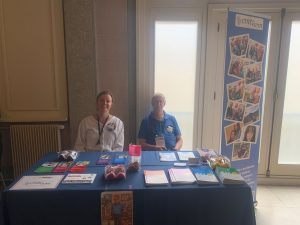
We also had a stand again in the dedicated area for patient organisations. As always, our stand was the most colourful one, and of course we once again had our famous little Dutch stroopwafels prominently displayed among our materials.
We brought a wide range of information materials with us, and many of these were taken by conference participants who visited our stand.
Nurses
Prof. Dr. Suzanne Pasmans led a workshop specifically for nurses. Unfortunately, most of the speakers were French-speaking, which remains a recurring challenge at international conferences.
Many others face the same issue, particularly in countries such as Italy and Spain. As a result, people from these countries are sometimes unable to participate fully in international activities because they do not have sufficient command of the English language.