


On Rare Diseases Day, February 28, 2026, patient organizations, healthcare professionals, and policymakers came together for an inspiring and educational day. The conference focused on collaboration, looking ahead, and above all, learning from one another.
New energy at VSOP
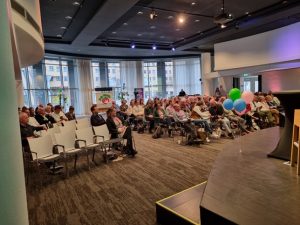 The day immediately felt like a fresh start. VSOP is clearly embarking on a new chapter. The new chair, Maria Kortekaas, introduced herself and indicated she was setting to work with great energy. Led by a pleasant and sharp moderator, it turned into an open, lively day with good conversations and room for everyone’s story.
Learning from each other
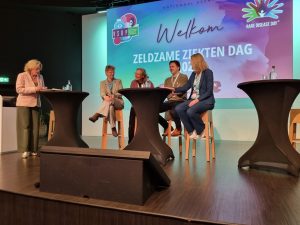
During the panel discussions, it was incredibly valuable to hear how other patient associations have organized their expertise networks. This resonated with many of us, but above all, it provided inspiration for our own Nevus Network. How do you make expertise discoverable? How do you ensure good collaboration? These are great examples to take away.
Towards a new National Plan for Rare Diseases
VSOP wants to launch a new National Plan for Rare Diseases together with many parties. The current plan dates back to 2013, so it is high time for renewal. The new plan will run for four years and must consist of achievable goals. That also means making choices.
There will be an evaluation and coordination meeting, in which coordination and multidisciplinary management play a major role. Not an easy task, but a very important one. The Ministry of Health, Welfare and Sport intends to start this process on September 26.
With the arrival of a new cabinet/government, we are immediately trying to draw attention to rare diseases with our signature on a large banner. Look at us, Sophie Hermans (Minister of Health, Welfare and Sport)!
Major challenges in healthcare
Several challenges faced by many patients with a rare disease were discussed:
- It often takes a long time before a correct diagnosis is made.
- Genetic diagnostics must be used earlier and more frequently. Even if no clear cause is found, it is important that people continue to be monitored.
- Early diagnosis (such as via the heel prick) is only useful if something can actually be done with the results afterwards.
- Interesting detail: on average, everyone has about seven DNA abnormalities that by no means always have consequences.
Where is the expertise – and how do you find it?
A recurring question: where is the expertise located, and how do you access it as a patient? For instance, Spierziekten Nederland has six university medical centers (UMCs) with an expertise label, each with its own specialty.
The discussion focused, among other things, on care pathways: should these differ per expertise center or be uniform nationwide? National care pathways provide clarity for patients, but doctors warn that this could limit innovation. Differences between centers are significant, and customization remains important. What did become clear, however, is that working in an expertise center requires committed, driven doctors who collaborate effectively.
Expertise centers are assessed via the ECZA procedure. If a center is rejected, it should technically no longer be allowed to call itself an expertise center – but unfortunately, this does not always happen. A recognized title would provide much clarity in this regard.
Additionally, European guidelines (ERNs) play a role. All of this currently results in an enormous amount of duplicate administration in various databases. Doctors sometimes have to literally retype information. There is clearly room for improvement here.
Inspiring examples
We examined how various conditions have structured care. For instance, ARCH was mentioned as a prime example: a platform that makes expertise accessible and shares and expands knowledge.
The care model surrounding neurofibromatosis NF1 was also discussed: four intervention centers collaborate with centers of expertise and the patient association. There is a quality committee, a care standard, and every patient has a coordinating physician. A powerful collaborative model.
Orphan drugs: expensive, but valuable
Jacqueline Noordhoek spoke about orphan drugs. Over the past 10 to 15 years, medicines have emerged that enormously improve the quality of life. They are often expensive, which leads to heated discussions. But when someone can work again, parents need to provide less informal care, and people can participate in society again, such a medicine proves to be relatively very beneficial.
At the same time, there is the broader question: how do we keep healthcare affordable, given an aging population and an increase in chronic diseases?
Role of patient representatives
Medicines must first be approved by the European Medicines Agency, followed by price negotiations. It is precisely here that an important role is reserved for patient representatives. The call was clear: organize yourselves, especially at the European level, for example through EUPATI (a training program for patient representatives).
For our constituency, orphan drugs are not yet a direct issue, but this could change in the future. Drugs are currently under development for NCM and melanoma. It is instructive to see how this process has unfolded for other conditions, such as cystic fibrosis.
Finally
The congress demonstrated the extent of knowledge, commitment, and motivation within the field of rare diseases. By working together, sharing experiences, and actively involving patients, we are taking steps forward.
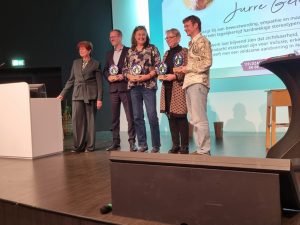 This year, the Rare Angel Awards went to:
- Dr. Rogier Veltrop Award for Lifetime Achievement.
- Dr. Jacquelien Noordhoek Award for Patient Representative for the Cystic Fibrosis Association.
- Prof. Dr. Martina Cornel Award for Researcher or Healthcare Professional.
- Jurre Geluk Award for Media for his program ‘Je zal het maar hebben’.
- Jurre Geluk: “Thank you for this wonderful prize, which I cannot win alone, but which I receive because everyone participated in the programs we create together.”
An inspiring day – and one that certainly leaves you wanting more.
CMTC-OVM Rare Disease Day video 2026
With thanks to Marjolein van Kessel (Nevus Network Netherlands) for preparing this report.