What are blood vessels and what do they do?
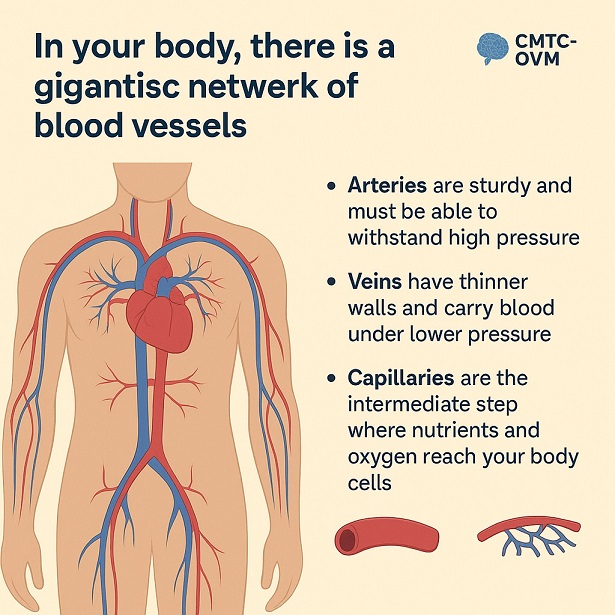
Your body contains a vast network of blood vessels: arteries (which carry oxygen-rich blood away from your heart), veins (which return oxygen-poor blood to your heart), and capillaries (tiny vessels where oxygen, nutrients, and waste are exchanged).
-
Arteries are strong and must withstand high pressure.
-
Veins have thinner walls and carry blood under lower pressure.
-
Capillaries are the in-between vessels where nutrients and oxygen reach your body’s cells.
What is the purpose of blood vessels?
-
They transport oxygen and nutrients to your organs and tissues.
-
They remove waste products and help keep your body in balance.
-
They regulate body temperature, support your immune system, and play a role in wound healing.
What are vascular malformations and how do they affect your body?
Vascular malformations are congenital abnormalities in the structure of blood vessels. They are present from birth, although sometimes they only become visible or noticeable later in life. There are different types:
Arteriovenous malformations (AVM)
A direct, abnormal connection forms between an artery and a vein, bypassing capillaries. Blood flows under high pressure directly into the vein, which can swell and become damaged. This may cause pain, skin problems, bleeding, or even heart issues.
Venous malformations
Veins are weak and enlarged, creating bluish swellings that may get bigger during activity or when the limb is lowered. Pain, inflammation, or growth restrictions can occur. During puberty or hormonal periods (like pregnancy or contraceptive use), these malformations may grow.
Capillary malformations (such as port-wine stains)
These are abnormalities in the capillaries, visible as red marks on the skin.
Complex or combined forms
Some people have multiple types simultaneously, such as in Klippel-Trenaunay or Sturge-Weber syndrome.
Effects during puberty and adulthood
-
Puberty: Hormonal changes can cause some vascular malformations, like venous malformations, to grow or become more visible.
-
Adulthood: AVMs can cause symptoms such as pain, bleeding, or even heart problems, especially if they enlarge.
-
Malformations often only show symptoms later in life when they become large or active enough to be noticeable.
Why is this important now?
Living with a vascular malformation as a young person can bring challenges:
-
Self-image & confidence: Visible abnormalities can affect self-esteem.
-
Treatment and care: Seeing a specialist may be important (diagnosis via ultrasound, MRI, or CTA).
-
Long-term impact: Growth during puberty or hormonal changes can worsen the condition.
-
Active guidance: Organizations like CMTC-OVM can help you navigate information, peer support, and medical care.
Summary at a glance
| Topic |
Explanation |
| Blood vessels |
Arteries, veins & capillaries transport blood and vital substances. |
| Vascular malformations |
Congenital abnormalities in vessel structure. |
| Main types |
AVM, venous, capillary, combined. |
| Effect on the body |
Pain, bleeding, growth issues, heart strain. |
| Puberty & adulthood |
Hormonal changes can affect growth or symptoms. |
| Importance of guidance |
Info, peer contact, and care (like CMTC-OVM) can help. |
In plain words: what does this mean for you?
Living with a vascular malformation means you sometimes need to pay extra attention to your body, especially during growth phases like puberty. You don’t have to manage this alone. Reliable sources (such as CMTC-OVM) and medical options exist to support, inform, and answer your questions.