


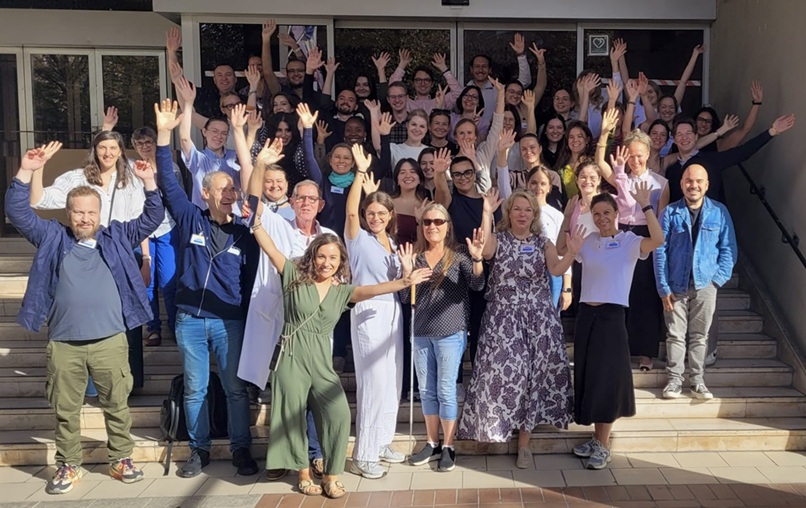
The European organisation for rare diseases organised the Summer School on vascular malformations in Paris from 14 to 19 September 2026.
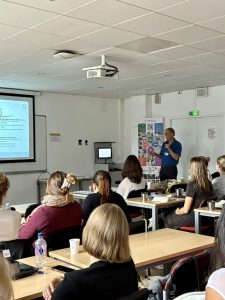
Our organisation is part of the European network for vascular malformations (European Reference Networks). Within this network, we are actively involved in the VASCA Working Group. This year, Lex van der Heijden represented the VASCA WG and gave a presentation about the activities and work of the group. Lex also highlighted the psychological and psychosocial aspects of living with a rare condition in general.
Our CMTC-OVM organisation served as a practical example of the added value a patient organisation can provide to people living with a rare condition, their families, and healthcare professionals. This was illustrated by our Cloverleaf Model, with a banner showcasing several examples of the support and benefits we offer.
Of course, Lex had brought a large supply of traditional Dutch stroopwafels, which disappeared at an impressive speed!
The VASCERN Summer School 2026 ended with an onsite week in Paris this September, gathering medical students, residents, and post-doctoral researchers from across Europe for six days of teaching on rare vascular diseases. The programme, an Erasmus+ Blended Intensive Programme, follows fifteen weeks of online study, with the Paris week serving as its practical and clinical centrepiece.
From Genetics to Clinical Practice
Over the six days, students worked through six disease areas: Heritable Thoracic Aortic Diseases, Medium Sized Arteries conditions, Neurovascular diseases, Paediatric and Primary Lymphoedema, Vascular Anomalies, and Hereditary Haemorrhagic Telangiectasia. Each course followed a similar rhythm starting with underlying biology, genetics, pathophysiology, and diagnostic criteria, before moving into treatment and management.
This week opened with Heritable Thoracic Aortic Diseases, taught by Prof. Laura Muiño Mosquera, Prof. Guillaume Jondeau, and Dr. Anna Sabaté-Rotés, and closed with students bringing their own clinical cases to the group for discussion.
That pattern, teaching followed by application, repeated across the week. Medium Sized Arteries conditions came next, with Prof. Laura Muiño Mosquera, Prof. Tristan Mirault, and Dr. Michael Frank taking students from vascular Ehlers-Danlos Syndrome genetics to the realities of arterial dissection management.
Day two and three covered Neurovascular diseases spanning CADASIL with Dr. Gido Gravesteijn and Dr. Stéphanie Guey, then Moyamoya angiopathy with Dr. Nicola Rifino and Dr. Dominique Hervé, and closing with a student case presentation of their own.
Day three covered Paediatric and Primary Lymphoedema, led by Dr. Vaughan Keeley and Prof. Sarah Thomis, paired clinical teaching with two hands-on workshops, building genealogic trees and practising compression bandaging techniques directly.
Day four was one of the busiest single day of the week, covering six distinct vascular malformation types with Dr. Annouk Bisdorff, Dr. Andrea Diociaiuti, Dr. Bitten Schönewolf-Greulich, Dr. Nader Ghaffarpour, and Dr. Olivia Boccara, woven throughout with short patient films.
Day five covered Hereditary Haemorrhagic Telangiectasia closing the clinical programme, and opening with a patient’s story before any teaching began, then moving through nosebleeds, organ involvement, and treatment with Prof. Urban Geisthoff, Dr. Sophie Dupuis-Girod, and Dr. Antonio Cerrone.
Learning Directly from Patients
 Every course included a session with a VASCERN ePAG patient advocate, and these were, without exception, the moments students spoke about most.
Lida Korpela spoke about living with Marfan syndrome and HTAD, describing a life that “takes so much energy and time.” Alessandra Veronese talked about her son’s diagnosis, calling it both a relief and a new reality, and the “never ending search for support” that followed. Elisabeth Lisack shared what it means to live with CADASIL, and the guilt, fear, and anxiety that ripple through a whole family.
Carina Mainka spoke about caring for her son, who has a KIF11 gene variant, and her family’s choice not to let it define their life.
Lex Van Der Heijden and Göran Westerlund brought their own perspectives on Vascular Anomalies and HHT respectively, each reinforcing the same point: a diagnosis is never only clinical.
The Final Day
The final day, Saturday, moved away from lectures entirely. Students took part in communication skills role play, working through real scenarios as both doctor and patient, facilitated by Carolina de Toma, Anne-Mette Bredahl, Sabine Hellemans, Prof. Urban Geisthoff, Dr. Meike Rybczynski, Dr. Tobias Geisel, and NEUROVASC ePAG advocate Elisabeth Lisack.